
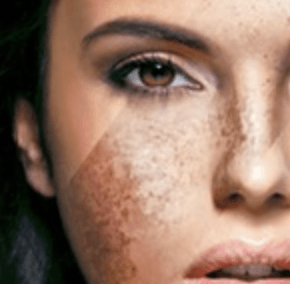
Here at Cheshire Lasers, we offer a wide range of treatments for reducing pigmentation. Different treatments often suit different pigment conditions.
On this page, we discuss the different conditions and what we recommend to improve them.
Birthmarks
Some birthmarks are easy to treat, while others are much more difficult. At Cheshire Lasers, we successfully treat vascular birthmarks such as port wine stains with our advanced IPL Lumina system.
Brown birthmarks are much harder to treat and do not always respond; an ND: YAG laser would be used to treat this type of pigmentation. If the brown birthmark responds and goes away, there is a 50% risk it will recur over a 2-year period. We often recommend you visit Lynton Lasers in Homes Chapel for these, as they have a different laser available.
Age spots and Freckles
Age spots—also known as sun spots or liver spots—are a common form of pigmentation caused by prolonged sun exposure.
At Cheshire Lasers, we offer a range of advanced treatments to effectively reduce or remove age spot pigmentation.
View details of all our treatments for sun spots, liver spots, and sun damage here.
Melasma
Melasma presents as dark, irregular patches on the face that develop over time. The dark patches are commonly found on sun-exposed areas such as the upper cheeks, nose, upper lip and forehead. Melasma is most common in women and is often triggered by pregnancy and or the contraceptive pill. Melasma worsens when the skin is exposed to sunlight, especially in the summer.
Treating melasma can be challenging. The superficial (epidermal) type melasma often shows an excellent response to therapy. However, deeper melasma (dermal melasma) can often be resistant to many treatments. This is why the first step to treatment involves a detailed consultation with one of our healthcare professionals. The cause and type of melasma can be established and treatment can be individualised and tailored to each patient’s needs.
There are several treatments available at Cheshire Lasers to treat Melasma.
The Obagi NuDerm system
The Obagi NuDerm system gives fantastic results with melasma, even after a few weeks use, the pigment usually looks so much better. You need to continue on the system for 18 weeks, after which your skin usually looks great. After 18 weeks you need to go on to a simpler maintenance regime to avoid rebound pigmentation. If you suddenly stop the treatment, the pigment usually comes back. Occasionally, stubborn Melasma may need a peel to complete the treatment on this system.
Cysteamine Products
Cystamine is a fantastic skin-lightening agent used to treat hyperpigmentation disorders such as age spots, melasma and post-inflammatory hyperpigmentation.
It is a novel, highly effective alternative to prescription treatments such as hydroquinone and tretinoin. All skin types can use Cysteamine, including dark skin and is a great option for stubborn pigmentation, including melasma and post-inflammatory pigmentation
Senté Cysteamine HSA Pigment & Tone Corrector is the most potent product currently available containing 5% Cysteamine which is applied like a mask.
Dermaquest Melaquest Cysteamine products have a lower % ( 4% for the serum and 3% for the cream) but can be left on the skin.
To discuss this, book a consultation with Sultana or Anna.
Laser Treatments
At Cheshire Lasers, we do not use our Intense Pulsed Light or ND Yag Laser to treat Melasma. There is a higher risk of side effects and the response rate is poor.
Preventing Melasma and Pigmentation
The challenge with treating melasma and other pigmentation disorders is that they commonly relapse after treatment.
The most important way to prevent pigmentation is to wear good sun protection all year round and a sunblock in the Summer.
To try to prevent melasma and stubborn pigmentation, maintenance therapy is required. This can be performed using the same skin care products used for treatment, but on a maintenance regimen.
We recommend regular reviews at the clinic in case your regimen needs to be changed. So we can help you manage the pigmentation to reduce the risk of it returning.
For all conditions, a layered approach works best:
- Reduce pigment production
- Remove existing pigment with your treatment of choice
- Prevent recurrence
A High SPF and topical products are an important part of your regimen.
Find out more general information about pigmentation removal at Cheshire Lasers Clinic here.