
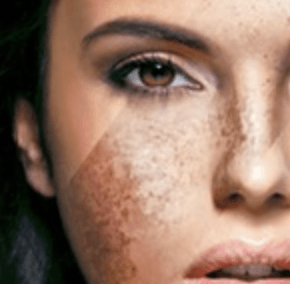
At Cheshire Lasers Clinic, we are often asked: “How can you remove my pigmentation?”
There are many types of pigmentation, with many different causes; some can be treated more easily than others. At Cheshire Lasers, we also have many different treatments that can help you.
The way we treat your pigmentation is based on:
- It’s cause
- Your skin type
- Most importantly, your preferences
How do I decide which Pigmentation treatment to choose from?
At Cheshire Lasers, we offer a wide range of pigmentation removal products and treatments. This makes it hard to decide what to do.
Some treatments work more quickly and are better than others. However, these treatments also tend to cause more side effects, more downtime and are more aggressive.
The gentler treatments tend to take much longer to work. You therefore have to be patient and follow the recommended treatment protocol.
Types of Pigmentation we treat
Your skin gets its colour from a pigment called melanin. Special cells called melanocytes in the skin make melanin. When these cells are damaged or activated, melanin production is affected.
☀️ Superficial Pigmentation (Sun Damage & Age Spots)
This type of pigmentation sits in the top layer of the skin and is caused by UV exposure.
Common examples: Age spots (sun spots/liver spots), freckles, Localised sun damage
✔ Well-defined brown marks
✔ Common on face, hands, chest
✔ Responds quickly to treatment
👉 Best approach: remove the pigment
🌫️ 2. Deeper Pigmentation (Melasma & Hormonal Pigment)
This type sits deeper in the skin and is often triggered by:
Hormones (pregnancy, contraception), heat, and sun exposure and people can also have a genetic predisposition
Example:
Melasma
✔ Patchy or diffuse pigmentation
✔ More likely to return
✔ Requires careful management
👉 Best treatment approach: control pigment production and maintain results
🔥 3. Post-Inflammatory Pigmentation (PIH)
This type of pigmentation develops after skin inflammation or trauma. Common triggers include acne or breakouts, eczema or skin irritation as well as skin injury, picking and aggressive skin treatments or inflammation
✔ Flat brown or grey marks left after healing
✔ Common in acne-prone or sensitive skin
✔ Can affect all skin types (more persistent in darker skin tones)
👉 Best approach: calm the skin + regulate pigment production + gradual fading
Treatment Options by Pigmentation Type
Superficial Pigmentation (Fast Removal Treatments)
These treatments break down visible pigment:
- IPL (Intense Pulsed Light) targets melanin in sun spots and freckles
- Laser Pigmentation Removal targets more stubborn pigmentation
- Cryotherapy freezes and destroys individual age spots
- View more details here
Deeper Pigmentation (Control & Regulation Treatments)
These treatments reduce pigment activity and improve skin balance:
1) Chemical Peels brighten overall skin tone and fade pigmentation gradually
BioRePeel, phFormula Mela Treatments, Blue Radiance Peel, ZO Peels, and Hydrafacial,
2) Medical-Grade Skincare
Prescription-only Obagi Nuderm System to treat melasma, and moderate to severe pigmentation problems.
Cysteamine products help regulate melanin production, especially effective for melasma and PIH. Used for long-term control and maintenance
ZO Skin Health System and the PhFormula Mela and Tranexamic acid products for pigmentation problems.
What do I do if I want pigmentation removal at Cheshire Lasers?
We recommend an initial consultation with one of our specialists for pigmentation problems before starting any treatment.
It is helpful to know what sort of treatment you are interested in so we can book you with the right person.
If you are considering starting any pigmentation treatment, ensure you do not plan any sun exposure for the next few months. If you go out in the sun, you will need to cover the area with very high sun protection and keep it covered.
For laser/IPL treatment, you MUST NOT HAVE A SUNTAN during treatments and must avoid the sun completely for 4 weeks after a course of treatment.
The sun will stimulate pigmentation and undo the results of your treatments. It can also increase the risk of complications in your treatment.
At Cheshire Lasers, Pigmentation Removal Treatments are provided by:
Dr Hazlehurst uses the topical prescription Obagi NuDerm system, she also uses cryotherapy for small localised patches of superficial sun damage. Dr Hazlehurst also performs the CliniCare Glow Peel and the Blue Radiance Peel.
Sultana Udin, Senior Aesthetician and Level 4 Laser / IPL Technician.
Sultana uses IPL and, sometimes, the ND: YAG to treat pigmentation with our Lynton Lumina ASQ system.
She also uses Cysteamine Creams, excellent for most pigmentation concerns, including melasma and darker skin types.
Sultana also uses the ZO Medical system and the PhFormula Mela Products for pigmentation problems.
Sultana also performs a wide range of facial peels and all of our resurfacing treatments designed to improve mild to moderate pigmentation as well as skin texture.
Booking a consultation
Please give us as much information about your concern when booking so we can ensure you get the most from your consultation.
You can book either of the following appointments with Sultana:
Skin Rejuvenation Consultation for other pigmentation treatments
Book a consultation with Dr Hazlehurst to discuss Cryotherapy, her skin peels and the Obagi NuDerm system for more stubborn pigmentation.

During your consultation
We will examine your skin, take your medical history, and help you decide on the most suitable treatment. We will also discuss the risks, costs and recovery period associated with the procedures you are considering.
Find out more information about how to treat different types of Pigmentation conditions here.
Preventing Pigmentation
The challenge of treating Melasma and pigmentation is that it commonly relapses after treatment.
The most important way of preventing pigmentation is to wear good sun protection all year round and a sun block in the Summer.
Try and avoid any other triggers that may stimulate the problem.
To prevent Melasma and stubborn pigmentation returning, maintenance therapy is required. You can opt for repeat treatments once the pigment has returned. However, we usually recommend selected topical skin care. If you start it immediately after treatment with regular reviews at the clinic in case your regimen needs changing, we can help you manage the pigmentation to reduce the risk of it returning.